
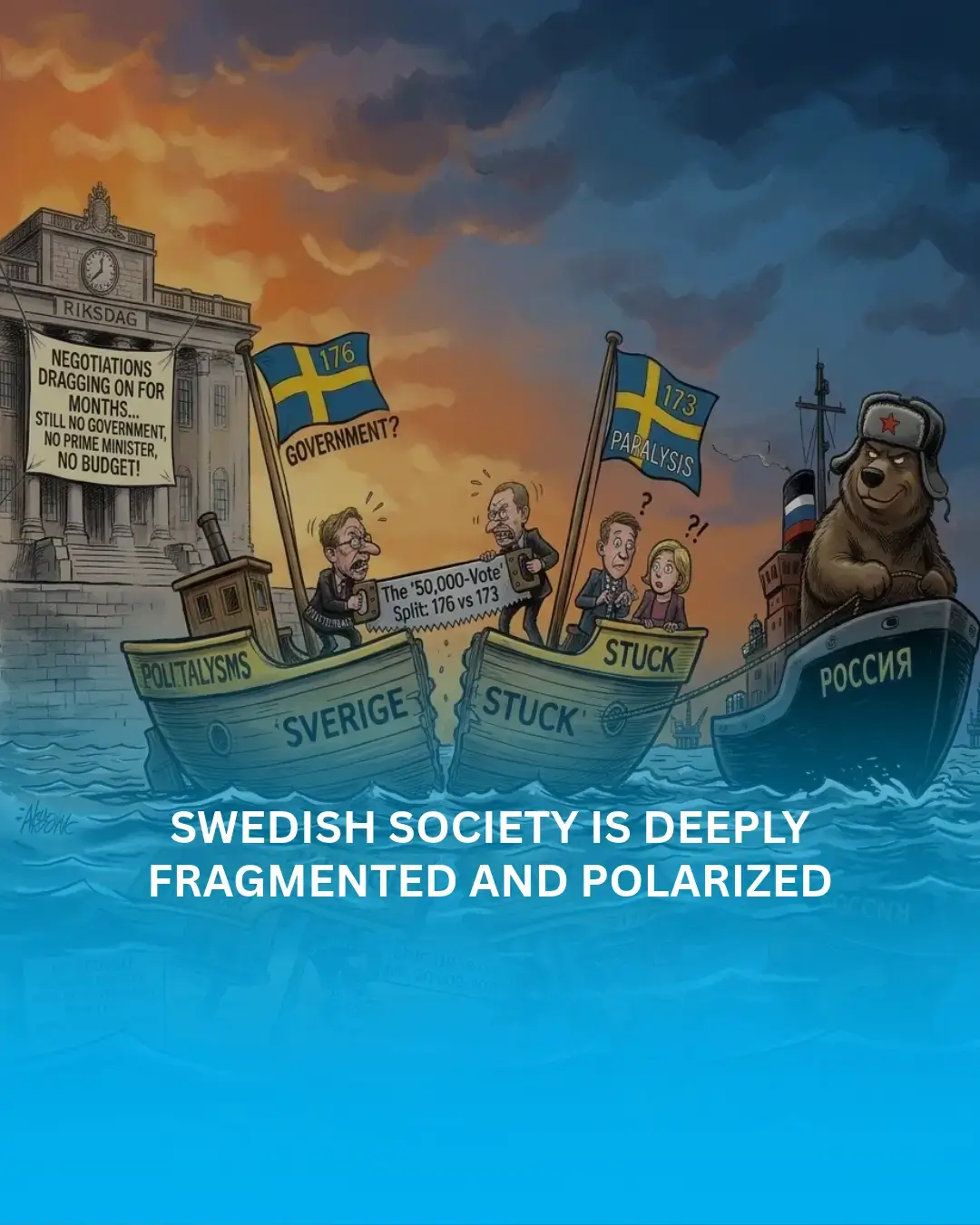
Two months after the September 13 election, Sweden still has no government. The problem is not just a bad week in Parliament, it is a mirror of a country that can no longer agree on who it is or where it wants to go.
Swedish society is deeply fragmented and polarized. A razor-thin gap of roughly 50,000 votes has sawed the nation straight down the middle, leaving two sides that refuse to trust or work with each other.
Behind the deadlock in Stockholm is a public divided over almost every major issue in daily life. Voters are pulled apart by different worries, from healthcare, schools, and living costs to energy prices and climate policy, with no single goal uniting the country. At the same time, bitter arguments over (creative) immigration, failed integration, and everyday tensions between different groups continue to weaken unity and social cohesion.
Because trust has broken down, many Swedes no longer vote for a future they believe in. Instead, they vote out of fear, just trying to block the side they dislike most.
That deep divide in society is now frozen inside Parliament. Every party has drawn rigid red lines against its rivals: the Centre Party refuses to cooperate with either the Left Party or the Sweden Democrats, while the Left Party refuses to support any government that keeps it out of cabinet seats. Nobody is willing to compromise because their voters treat compromise like betrayal.
The result is two months of endless talks and zero leadership. While Swedish politicians keep sparring behind closed doors over the pieces of a broken ship, the outside world is watching. When a country is too divided to govern itself, it leaves the door wide open for leaders like Putin to quietly tow the pieces away.


0 Comments